
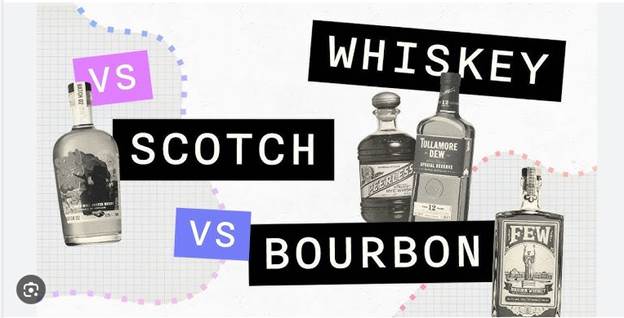
The most common thing I hear from people when I am out looking for a good bourbon. “You got any good whiskey like that Pappy or Four Roses has?” OMG do you all not know the differences in scotch, whiskey, and bourbon?
Well, if you give me your ear for a minute, I might clear up some confusion. Yes, they are all whiskey, in that whiskey is any spirit that is distilled from a grain to make alcohol. Here is where they all start to be VERY Very very different.

Scotch is a whiskey that must be manufactured in Scotland. Irish Whiskey in Ireland. Bourbons in the USA. Those geographic limits extend further with bourbon. Bourbon is considered the most regulated drink on this planet. Bourbon must be mashed, distilled, barreled, aged and bottled in the USA PERIOD.
Both Scotch and Irish whiskey must be made, distilled barreled and bottled in their base countries. It can be single malt, double malt, multi malt. It is usually barreled in an old bourbon barrel. Bourbon can only be barreled in an American Virgin White Oak Barrel. That barrel is usually charred to a level 3 or 4 before the distillate is poured in to serve its time. Once Bourbon is poured out of the barrel, it may not be used to make another bourbon. It is finished for bourbons, but there are other markets that use that barrel. Such as, whiskey, Scotch, Irish Whiskey, Wines, Tequilla, Beer and few others.
There is no age limit on how long whiskey has to age in the barrel. There is nothing that say it has to even be aged or even put in a barrel. Bourbon Must age for minimum of 2 years. If it is aged less than 3 years it must have an age statement reporting that information. Bottled in Bond must be aged a minimum of 4 years. Most of the best bourbons are aged 6 or more years.
Bourbon is 51% corn, not more than 80%, then it ususally has rye, malted barley and sometimes wheat in the mash bill or recipe. Whiskey is made with any grain at any level as long as it makes a grain alcohol.
There are no limits on the proof of alcohol for Whiskey. It can be barreled at any proof; it can be bottled at any proof. Bourbon cannot be barreled for aging at anything above 125 proof. I can’t be bottled for less than 80 Proof. In fact, the term “86 that” comes from a time when people were taking 100 proof whiskey and cutting it with anything they could to increase what could be bottled, leaving the consumer with an inferior product and usually dangerous.
Bourbon gets its color, taste, smell from aging in that charred virgin oak barrel. It may not contain any artificial colors or flavors. This rule does not apply to whiskey. In fact, there are many flavored whiskeys. And coloring can be added to make whiskey to make it look appropriate and appetizing.
Because of the rules and restrictions on bourbon, it is made exactly the same by ALL Bourbon distilleries, which gives it a lot of integrity that that product is pure, exact and has no rule breaking to give the customers a bad or inferior product. In fact, because of using just those rules you get a great product and something you can rely on. For more information please refer to the Bottle in Bond Act 1897, The Food and Drug Act 1905 and the Bourbon Act 1963.
To sum it up, drink your whiskey if you like whiskey, rather its flavored, corn, rye or Tennessee. Drink you some Scotch, I like Glenfiddich and McMillian. Go get some Irish Whiskey like Jameson or Pierce. But do not confuse any of that for something as golden, pure and delish as bourbon.
-Rich Pesta
 More than sipping corn